Thursday, February 7, 2013
Lesson ideas: Dice
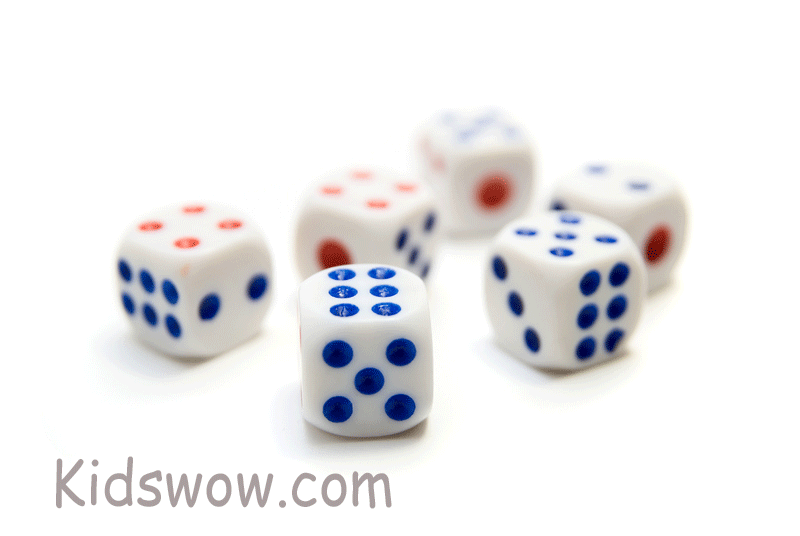
Need a new idea for teaching numbers? Try using dice!
Depending on the child's level, you can use 1 or more dice. To teach the numbers 1 through 6, use one die. If you use two, you can teach 1 through 12! With three dice you can practice up to 18! With small kids we often count the dots on the dice. 1, 2, 3, 4...
Counting with dice can be a lot of fun! Try it!
More materials on our website: kidswow.com
Saturday, January 26, 2013
Word for Today: RECENTLY
Today's Word: Recently

Definition:
lately, occurring not long before
Pronunciation:
REE sent lee (listen to the pronunciation here)
Example Sentences:
She graduated from college recently.
Recently designed buildings have been very unique.
Several businessmen recently went to the small cafe.
Have you watched any movies recently?
Recently, the monkey has been acting strangely.
What to learn more English? Check out our website: Kidswow.com

Definition:
lately, occurring not long before
Pronunciation:
REE sent lee (listen to the pronunciation here)
Example Sentences:
She graduated from college recently.
Recently designed buildings have been very unique.
Several businessmen recently went to the small cafe.
Have you watched any movies recently?
Recently, the monkey has been acting strangely.
What to learn more English? Check out our website: Kidswow.com
Tuesday, January 15, 2013
How you learn
Figuring out how your child learns best is important. Some kids like to be active, while others prefer to sit. Knowing how your child likes to learn can improve results. Sometimes a child likes to be consistent. They may learn best when you teach them in a certain way, at a certain place, at a specific time. Other kids must have variety! They get bored quickly and cannot stay in one place for very long. You must use more creativity, but it isn't too difficult to teach them either. You may have to change the time at which you teach or the location or the style, but you won't necessarily have to change everything. Often a small change will help the child regain interest and concentration.
Try a variety of teaching methods to determine how your child learns best. Click here to get 10 ideas of different ways to teach simple lessons.
For more teaching material check out our website: kidswow.com
Try a variety of teaching methods to determine how your child learns best. Click here to get 10 ideas of different ways to teach simple lessons.
For more teaching material check out our website: kidswow.com
Tuesday, January 8, 2013
Lesson Ideas: Using Variety
We use a variety of lesson styles so that we limit boredom in our classes. If your child is finding it hard to concentrate, it may be time to switch styles.
Sometimes we teach with actions (like jumping, sitting, walking...), or we may play a game to boost motivation. Sometimes we read books, sometimes we sit in chairs at a table, and other times we sit on the floor. Having a variety of ways to teach a lesson is important. Not only does it help the students stay interested, it also keeps the teacher from getting bored.
If I was teaching a child simple colors, here are 10 examples of how I could teach.
1. Use flashcards. Say the color and have the child repeat it.
2. Use a paper with several colored squares on it and ask the child, "Where is the Blue?"
3. Point to objects in a room and name the colors.
4. Have the child search for something 'Green'.
5. Use colored objects. Ask the child which color he wants.
6. Give the child some colored objects, ask him "What do you have?".
7. Put flashcards in a circle on the floor. Walk on the circle humming. Stop humming and say "stop!". Have the child say the color he is standing on.
8. Use UNO cards (colored numbers). Play Go Fish by asking "Do you have a yellow card?" Make pairs of cards and put them in front of you (two yellow or two greens etc.). Once someone runs out of cards, count your pairs. Whoever has more pairs is the winner!
9. Put some colored balls in the corner of the room. Sit several meters away and tell the child, "Go get a Purple ball". Have a basket near you to collect the balls he brings back.
10. Lay flashcards on the floor in a long line. Stand at one end of the line and have the child stand at the other. When you say 'Go!' walk towards each other saying each color. When you reach each other somewhere in the middle, Janken (Rock, Paper, Scissors). Whoever loses returns to the beginning and starts over. Play until someone reaches the opposite side.
There are lots of ways you can teach simple English lessons. Have fun! Explore! Be creative! Teaching is all about being with your kids and using English words. It is not hard.
More teaching materials at kidswow.com
Sometimes we teach with actions (like jumping, sitting, walking...), or we may play a game to boost motivation. Sometimes we read books, sometimes we sit in chairs at a table, and other times we sit on the floor. Having a variety of ways to teach a lesson is important. Not only does it help the students stay interested, it also keeps the teacher from getting bored.
If I was teaching a child simple colors, here are 10 examples of how I could teach. 1. Use flashcards. Say the color and have the child repeat it.
2. Use a paper with several colored squares on it and ask the child, "Where is the Blue?"
3. Point to objects in a room and name the colors.
4. Have the child search for something 'Green'.
5. Use colored objects. Ask the child which color he wants.
6. Give the child some colored objects, ask him "What do you have?".
7. Put flashcards in a circle on the floor. Walk on the circle humming. Stop humming and say "stop!". Have the child say the color he is standing on.
8. Use UNO cards (colored numbers). Play Go Fish by asking "Do you have a yellow card?" Make pairs of cards and put them in front of you (two yellow or two greens etc.). Once someone runs out of cards, count your pairs. Whoever has more pairs is the winner!
9. Put some colored balls in the corner of the room. Sit several meters away and tell the child, "Go get a Purple ball". Have a basket near you to collect the balls he brings back.
10. Lay flashcards on the floor in a long line. Stand at one end of the line and have the child stand at the other. When you say 'Go!' walk towards each other saying each color. When you reach each other somewhere in the middle, Janken (Rock, Paper, Scissors). Whoever loses returns to the beginning and starts over. Play until someone reaches the opposite side.
There are lots of ways you can teach simple English lessons. Have fun! Explore! Be creative! Teaching is all about being with your kids and using English words. It is not hard.
More teaching materials at kidswow.com
Friday, January 4, 2013
Word for Today: ALMOST
Today's word: almost

Definition:
not quite, very nearly, about
Pronunciation:
ALL mōst (you can hear the pronunciation here)
Example Sentences:
Want to learn more English? Check out our website: kidswow.com

Definition:
not quite, very nearly, about
Pronunciation:
ALL mōst (you can hear the pronunciation here)
Example Sentences:
It was almost a perfect day. The muddy path, however, made it hard to hike.
The food was delicious! It was almost like Chinese food, but not quite.
We almost caught the bus, but we were three minutes too late.
On the way home, the little girl almost fell asleep.
We almost always eat sushi on Sunday.
Want to learn more English? Check out our website: kidswow.com
Sunday, December 30, 2012
Colors are Everywhere!
Teaching colors is easy! Download our
simple color sheet below or just use what you have! Look around you! There are
colors all over the place. Point to the floor, carpet, or chair. Point to your
clothes or the clothes of your child. Have fun finding and saying colors
together.
Just teach what you know. Don’t worry if you can’t remember how to
say the color of the couch. Practice other colors! Yellow, brown, pink, red,
blue, green, black, white, purple, orange…! See if your child can find objects
with those colors.
Have fun!
Find more at Kidswow.com
Saturday, December 22, 2012
No Failure
No Failure is an important but very simple concept that many teachers do not grasp. It's the concept that a student can't fail. If the student tries or even listens to English, they are familiar with more than they were before. Thus they learned something and did not fail.
In order to use the No Failure method, you must change your definition of failure. A mistake is not a failure, it is an opportunity to learn. A wrong answer is not a failure, it helps the teacher determine the child's level.
Listening is critical in order to learn language. Even if all your child does is listen to you speak English, they will have had exposure to the language which will make it easier to learn later. Even if your child will not say any English, give them listening practice. Talk to them in English, tell them how to say things in English, and repeat your words regularly to increase familiarity. Listen to English CDs, or DVDs (preferably ones that actually repeat useful words or sentences. - Click here or visit our website to look into buying our DVDs kidswow.com/).
The concept that we have adopted for Kidswow English is that you can't fail in our classes, but you CAN succeed!
Subscribe to:
Posts (Atom)


